
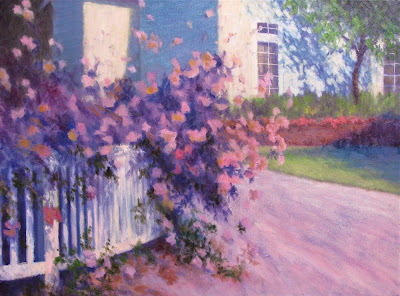
Work in Progress 18x24"
by Susan Roux
Good design. How important is it? Is it important to you?
A good design will hold your viewers eye, sending them on an exploration of your entire canvas.
It isn't extremely complicated. As a matter of fact, it can be quite simple. Keep your viewers interest. How do you achieve that? Shake it up a bit with variety to keep the eye stimulated and traveling about. You can focus on any of the design elements, use them in proportions near 2/3 to 1/3 and you're already off to a great start.
Design comes in right from the start. It isn't something that just happens on your canvas. Consistent good design is planned. When you select a photo or arrangement to paint, there's always something about it that struck you, otherwise you wouldn't have chosen it in the first place. Identify that. Know why you've chosen a particular image to paint.
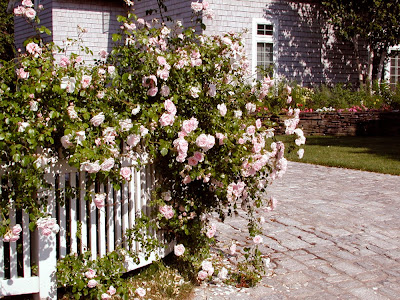
Here is the image I'm working from. It's quite obvious by the way I took this photo that the rose covered fence is what struck me most. If you think in terms of thirds, it's covering about 2/3 of the canvas. Rather than begin with an intense drawing of this complex scene, I chose to place my basic design lines first.
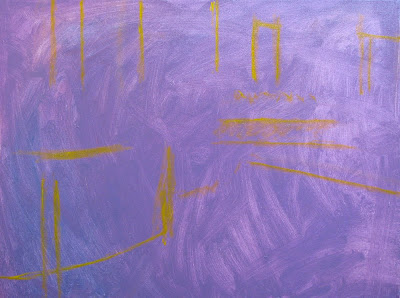
As I painted them in, I adjusted them. Though I was putting lines, my mind was imagining the bulky shapes these lines represented. I had to move several of them. It's a great time to back away and imagine your image within the boundaries you've created. At this point I was concentrating solely on design. Where am I going to place the components in my painting and how will they interact with each other in this placement?
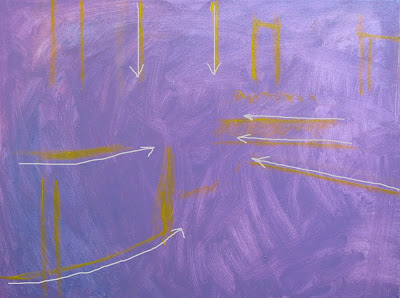
Notice how the lines already travel your eye in a unified direction. As I stepped back to imagine my scene, I thought of the direction things were pointing. Keeping in mind that my floral fence was my center of interest, I could see the movement in my painting was already supporting that. Don't loose sight of your initial idea. If it remains your goal throughout the painting process, the result will be more powerful than if you switched ideas on yourself along the way.
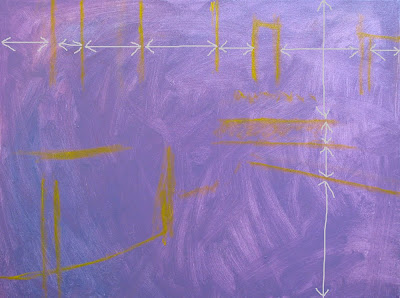
Next I looked at intervals. To keep the viewers eye interested, variety is necessary. Were my intervals varied enough? Not at first. I had to move most of these lines, because as I followed my photo, the lines seemed to be evenly spaced. For the sake of a painting, even if representational, it's better to create interest than to copy an image precisely. (Save that for when you're doing portraits.)
Paying attention to the bare bones of your painting is simple. By doing so, it allows you to concentrate on what you've created that is already working for you. In this case I identified direction. Don't you just love pointers? Make sure their helping you and not pointing the viewer in the wrong direction...
As I continue to develop this painting, I'm keeping in mind this directional movement. I'm supporting it with the colors I'm choosing and the values I'm placing. The bare bones are there to help me, but it's necessary to keep adjusting things as I go along. This will help me build upon the initial structure. Concentrating on good design is a good way to improve your work.
I'll continue to show you the development of this painting, explaining my thought process as I make choices. You'll see how the various elements of design come into play individually. Breaking things down simplifies the process. So rather than have to concentrate on all the elements of design at once, thinking of them one at a time and adjusting them, just as I adjusted my initial lines, becomes easy to understand.

